Sync vs split_io
How does dataplane.runtime: sync
compare to split_io under
forward_fast and
forward_slow?
Numbers are same-host comparisons on a single reference host and are not service-level objectives. See the performance hub disclaimer.
When this matters
Choosing a runtime model changes how
ingress and upstream I/O share threads.
sync keeps
receive and forward on the same workers;
split_io separates
ingress from async I/O workers. Architecture suggests slow upstreams can stall
sync ingress harder than
split_io; this study checks
that claim under paired load shapes on one lab. See also
worker counts
and the dataplane runtime tuning guide.
What we varied
- Varied:
dataplane.runtime(syncvssplit_io; paired slow runs under Member scenarios) - Held fixed: same dnsperf recipe, a single reference host, observability off fixtures
- Two load shapes:
forward_fastandforward_slow
Evidence
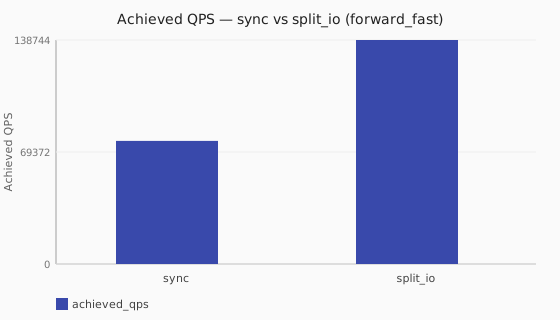
Achieved QPS — sync vs split_io (forward_fast)
| Runtime | Achieved QPS | Avg latency (ms) | Sent | Completed | Lost | Workers |
|---|---|---|---|---|---|---|
| sync | 76269.9 | 26.1 | 765379 | 765379 | 0 | ingress=2 |
| split_io | 138744.2 | 14.4 | 1389252 | 1389252 | 0 | ingress=2, policy=2, io=2 |
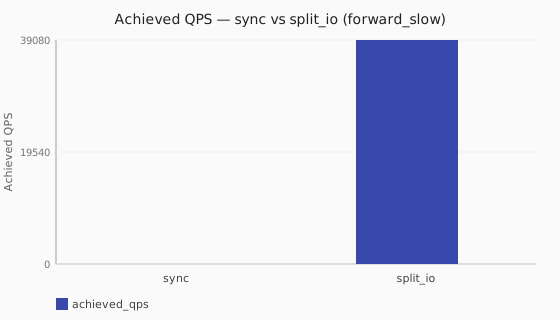
Achieved QPS — sync vs split_io (forward_slow)
| Runtime | Achieved QPS | Avg latency (ms) | Sent | Completed | Lost | Workers |
|---|---|---|---|---|---|---|
| sync | 5.7 | 2508.7 | 12188 | 198 | 11990 | ingress=2 |
| split_io | 39080.2 | 51.1 | 1174342 | 1174342 | 0 | ingress=2, policy=2, io=2 |
At a glance
- sync vs split_io (forward_fast):
split_iois about 1.8×sync(~139k vs ~76k). - sync vs split_io (forward_slow):
split_iois about 6889.8×sync(~39k vs ~6 QPS).
Takeaway
Against a fast upstream, split_io outperforms sync on this lab. Under
forward_fast,
split_io reaches about
1.8× the QPS of
sync (~139k vs
~76k) with lower average latency and little query loss.
Against a slow upstream, split_io still wins completion by a wide margin.
Under forward_slow, sync stays near
~6 QPS and lossy; split_io reaches about ~39k completed QPS with little loss
on this median. Prefer split_io when upstream wait owns the path.
What to do: prefer split_io when upstream wait matters; confirm on your
hardware with --study sync-vs-split-io.
Related guides
- Runtime and concurrency — sync vs split_io models
- Dataplane runtime tuning
- Reference: dataplane —
runtime,io_workers,policy_workers - Ingress concurrency (sync)
- I/O vs ingress (split_io)