Drain policy under slow upstream
How do complete, budgeted, and minimal drain policies behave under forward_slow
load at stop?
Numbers are same-host comparisons on a single reference host and are not service-level objectives. See the performance hub disclaimer.
When this matters
Shutdown and restart windows trade how long Conduit waits for in-flight work
against client failures during stop. See
graceful drain on shutdown.
Slow upstreams keep transactions outstanding longer, so
shutdown.drain policy choice shows up
clearly.
What we varied
- Varied: drain policy
(
drain_complete,drain_budgeted,drain_minimal) - Held constant:
forward_slowload overlapping SIGTERM, same lab recipe - Read the timing columns, not the throughput columns: these cells keep the thin load recipe on purpose, because the subject is what happens across the stop window. Their QPS and latency are incidental and are not a throughput ranking.
Evidence
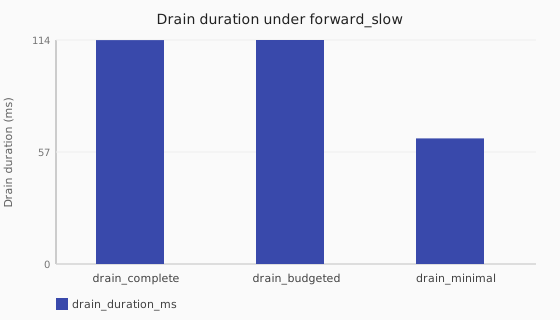
Drain duration under forward_slow
| Drain policy | Drain duration (ms) | Client failures during stop | QPS | Avg latency (ms) |
|---|---|---|---|---|
| drain_complete | 113.5 | 299 | 6.5 | 996.6 |
| drain_budgeted | 113.6 | 200 | 10.0 | 909.2 |
| drain_minimal | 63.7 | 200 | 9.7 | 902.1 |
At a glance
- Drain duration under forward_slow:
drain_complete≈ 114 ms,drain_budgeted≈ 114 ms,drain_minimal≈ 64 ms
Takeaway
Minimal drain stops fastest; complete leaves the most in-flight clients to fail. On this lab (median of three rounds), minimal finishes in ~64 ms; complete and budgeted both take ~114 ms. Complete records the most client failures during stop (299 vs 200 for the others) — a longer wait gives doomed slow-upstream requests more time to time out.
What to do: choose complete, budgeted, or minimal for your upgrade/restart window from your failure budget — pick a policy on purpose. Vocabulary: Performance methodology — Drain policy.
Related guides
Member scenarios
- shutdown-drain-complete-forward-slow
- shutdown-drain-budgeted-forward-slow
- shutdown-drain-minimal-forward-slow