Ingress concurrency (sync)
How much throughput do you buy by raising UDP ingress thread count under
dataplane.runtime: sync,
and does that answer change when the upstream is slow?
Numbers are same-host comparisons on a single reference host and are not service-level objectives. See the performance hub disclaimer.
When this matters
On sync,
listener ingress threads are the
main concurrency setting: the same workers receive the query and wait on the
upstream. Two questions follow from that, and this study runs the same worker series
twice to answer them separately. Against a fast upstream, where each worker's
wait is short, that series is a sizing curve — add workers until achieved QPS
flattens, then stop. Against a slow upstream, where each worker is parked for
the whole round trip, the series shows whether thread count is the binding limit
at all. Pair with listeners.reuse_port
when threads > 1. See
worker counts
and dataplane runtime tuning.
What we varied
- Varied: UDP listener
threads(1,2,4,8) withdataplane.runtime:sync - Varied: load shape —
forward_fastfor the sizing curve,forward_slowfor the slow-backend illustration - Held fixed: observability off fixtures, one dnsperf recipe per shape on the single reference host
- Note: the
ingress=2cell at each shape reuses that shape's sync scale cell
Evidence
Achieved QPS — sync ingress workers (forward_fast)
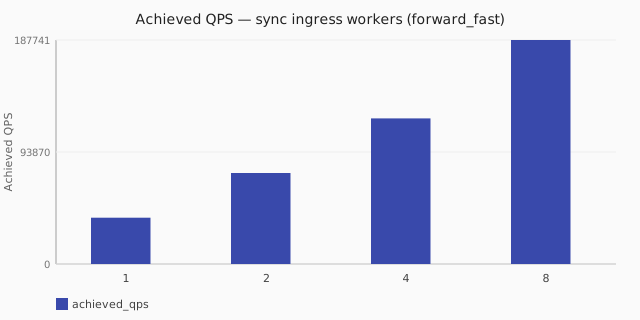
| Ingress workers | Runtime | Achieved QPS | Avg latency (ms) | Sent | Completed | Lost | Workers |
|---|---|---|---|---|---|---|---|
| 1 | sync | 38784.3 | 51.4 | 389857 | 389857 | 0 | ingress=1 |
| 2 | sync | 76269.9 | 26.1 | 765379 | 765379 | 0 | ingress=2 |
| 4 | sync | 122065.3 | 16.3 | 1224397 | 1224397 | 0 | ingress=4 |
| 8 | sync | 187740.5 | 10.6 | 1881076 | 1881076 | 0 | ingress=8 |
Achieved QPS — sync ingress workers (forward_slow)
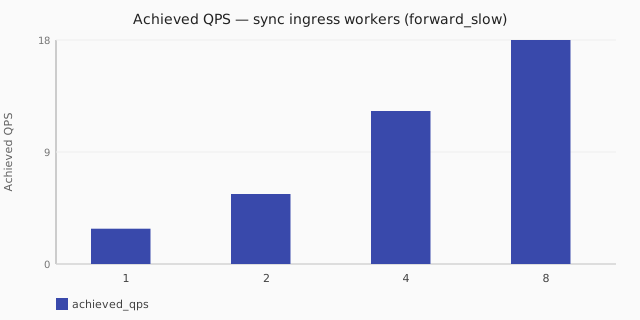
| Ingress workers | Runtime | Achieved QPS | Avg latency (ms) | Sent | Completed | Lost | Workers |
|---|---|---|---|---|---|---|---|
| 1 | sync | 2.9 | 2512.9 | 12094 | 99 | 11995 | ingress=1 |
| 2 | sync | 5.7 | 2508.7 | 12188 | 198 | 11990 | ingress=2 |
| 4 | sync | 12.4 | 2682.3 | 12393 | 433 | 11960 | ingress=4 |
| 8 | sync | 18.1 | 2601.7 | 12586 | 634 | 11952 | ingress=8 |
At a glance
- sync ingress workers (forward_fast):
2is about 2.0×1(~76k vs ~39k);4is about 3.1×1(~122k vs ~39k);8is about 4.8×1(~188k vs ~39k). - sync ingress workers (forward_slow):
2is about 2.0×1(~6 QPS vs ~3 QPS);4is about 4.3×1(~12 QPS vs ~3 QPS);8is about 6.4×1(~18 QPS vs ~3 QPS).
Takeaway
More sync ingress threads raise throughput against a fast upstream. On this
lab, under forward_fast, achieved
QPS climbs about ~39k → ~76k → ~122k → ~188k as you go from 1 to 2 to 4 to 8
workers. Gains stay large across that range on this median — keep adding threads
only while your remeasure still buys QPS.
Against a slow upstream, more threads help a little and do not fix the
model. Under forward_slow,
completed QPS scales with thread count (~3 → ~6 → ~12 → ~18) but stays tiny and
lossy. Prefer split_io
when upstream wait owns the path rather than stacking sync threads alone.
What to do: size sync ingress from the fast curve on your hardware
(--study ingress-concurrency-sync); pair reuse_port when threads > 1.
Related guides
- Runtime and concurrency — sync model and worker roles
- Dataplane runtime tuning
- Reference: listeners —
threads,reuse_port,rcvbuf - Reference: dataplane
- I/O vs ingress (split_io)
- Sync vs split_io