Memory vs LMDB warm cache_hit
How does a warm LMDB answer cache compare to a warm memory cache under
sync
cache_hit (read-mostly after warm)?
Numbers are same-host comparisons on a single reference host and are not service-level objectives. See the performance hub disclaimer.
When this matters
Use this pair when choosing between an in-process memory cache and a durable LMDB store for a warm, hit-dominated path. Both cells use the same elevated dnsperf window and warm probes before load. This study does not describe fill/evict churn, capacity pressure, or hit-rate under turnover — see Memory vs LMDB high-churn cache.
Configure backends under caches: and
lookup profiles. See
DNS answer cache and
Performance methodology — LMDB cache cells
(real disk for publish; lmdb.sync: full).
What we varied
- Varied: cache backend (memory vs LMDB) under warmed
cache_hit - Held constant:
syncruntime, ingress workers, observability off, elevated dnsperf recipe
Evidence
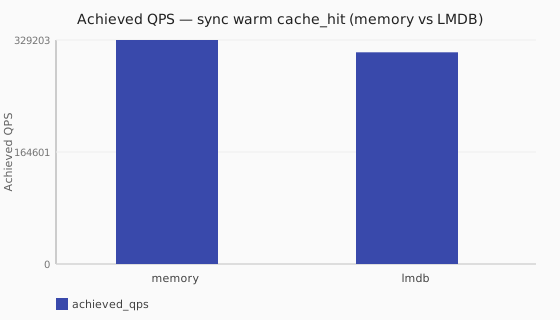
Achieved QPS — sync warm cache_hit (memory vs LMDB)
| Cache Backend | Runtime | Achieved QPS | Avg latency (ms) | Sent | Completed | Lost | Workers |
|---|---|---|---|---|---|---|---|
| memory | sync | 329202.8 | 6.1 | 3294253 | 3294253 | 0 | ingress=2 |
| lmdb | sync | 311061.7 | 6.4 | 3113021 | 3113021 | 0 | ingress=2 |
At a glance
- sync warm cache_hit (memory vs LMDB):
lmdbcosts about 6% QPS versusmemory(~311k vs ~329k).
Takeaway
Warm LMDB is close to warm memory on this lab. Under the same sync
cache_hit recipe, LMDB costs about
6% QPS versus memory (~311k vs ~329k). Treat that as a same-host upper-bound
comparison for a read-mostly path after warm — not a capacity target, not a
churn or hit-rate claim, and sensitive to disk / page cache. For turnover under
pressure, see
Memory vs LMDB high-churn cache.
See
Performance methodology — LMDB cache cells.