Split_io bulk thread topology
Does raising ingress, policy, and I/O worker counts together always help under
forward_fast?
Numbers are same-host comparisons on a single reference host and are not service-level objectives. See the performance hub disclaimer.
When this matters
It is tempting to raise all split_io
worker counts at once (listeners.threads, dataplane.policy_workers,
dataplane.io_workers — see
worker counts).
This study compares a modest baseline (2 of each) with doubling all three
together (4 of each) under forward_fast.
To see which setting actually helps, change one count at a time:
I/O vs ingress (split_io) and
ingress concurrency (sync).
What we varied
- Varied: all three worker counts together (2/2/2 baseline vs 4/4/4 doubled)
- Held constant:
split_io,forward_fast, observability off
Evidence
Achieved QPS — split_io topology (forward_fast)
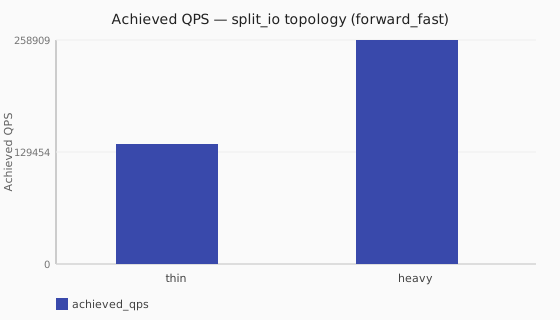
| Topology | Runtime | Achieved QPS | Avg latency (ms) | Sent | Completed | Lost | Workers |
|---|---|---|---|---|---|---|---|
| thin | split_io | 138744.2 | 14.4 | 1389252 | 1389252 | 0 | ingress=2, policy=2, io=2 |
| heavy | split_io | 258908.7 | 7.7 | 2590870 | 2590870 | 0 | ingress=4, policy=4, io=4 |
At a glance
- split_io topology (forward_fast):
heavyis about 1.9×thin(~259k vs ~139k).
Takeaway
Raising ingress, policy, and I/O together helps on this median — and is still
not a substitute for single-axis sizing. Topology-heavy (4/4/4) reaches about
1.9× the thin baseline (2/2/2) under
forward_fast (~259k vs ~139k).
What to do: treat the bulk pair as a ceiling check, not a tuning recipe. Size one setting at a time with Dataplane runtime tuning and the single-axis studies; remeasure the bulk pair on your hardware.
Related guides
- Runtime and concurrency
- Dataplane runtime tuning
- Reference: dataplane
- I/O vs ingress (split_io)
- Sync vs split_io