Memory vs LMDB high-churn cache
Under a matched high-churn recipe with enough sync ingress concurrency for both
backends to do useful parallel work, how do memory and LMDB answer caches differ
in achieved QPS and cache hit/miss ratios — and how do the four LMDB sync
durability modes (full, no_meta, periodic, none) compare under that same
recipe?
Numbers are same-host comparisons on a single reference host and are not service-level objectives. See the performance hub disclaimer.
When this matters
Use this study when you care about turnover under pressure — a query set
larger than max_entries, stub TTLs long enough that entry-cap eviction (not
TTL expiry alone) drives misses, and continuous fill/evict — not a warm,
hit-dominated path. Members use eight sync ingress workers, the same
elevated dnsperf window, the same 4096-name query file, a 60 s stub TTL, and
max_entries: 2048. LMDB cells use when_full: evict_one, explicit
shard_count: 16 (2× ingress), distinct real-disk paths, and first-class
lmdb.sync values (full, no_meta, periodic, none) with a map size sized
so the entry cap binds first. The periodic cell uses sync_interval: 1s.
This shape is intentional: a two-worker sync path under the same elevated outstanding window mainly shows Little's Law queueing (avg latency ≈ outstanding ÷ QPS) and starves multi-env LMDB parallelism. Thin-ingress companion scenarios remain in the catalog but are not this study’s primary compare.
This study does not describe warm read-mostly cache_hit cost — see
Memory vs LMDB warm cache_hit.
Expiry vs eviction: lazy TTL expiry is wall-clock deterministic on read.
What is arbitrary under LMDB capacity pressure is when_full victim selection
(evict_one / sample), not the expiry clock.
Configure backends under caches: and
lookup profiles. See
DNS answer cache and
Performance methodology — LMDB cache cells
(real disk for publish; each LMDB cell annotates its lmdb.sync value).
What we varied
- Varied: cache backend (memory vs LMDB) and LMDB
lmdb.syncmode undercache_churn - Held constant:
syncruntime with eight ingress workers, elevated dnsperf recipe, query file, stub TTL,max_entries, LMDB shard count on LMDB cells, metrics scrape for hit/miss and fill/eviction path-duration evidence
Evidence
Achieved QPS — sync ingress-8 high-churn (memory vs LMDB sync modes)
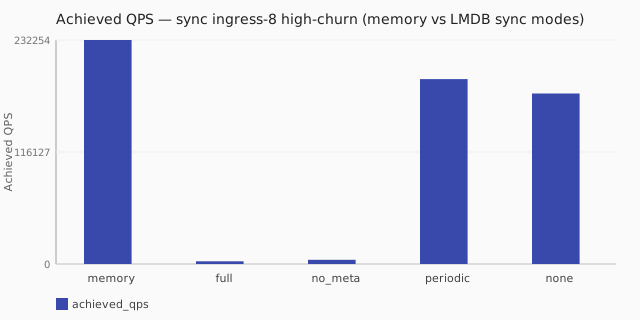
| Lmdb Sync | Runtime | Achieved QPS | Avg latency (ms) | Sent | Completed | Lost | Workers | Hit rate (%) | Cache hits | Cache misses | Fill mean (ms) | Eviction mean (ms) |
|---|---|---|---|---|---|---|---|---|---|---|---|---|
| memory | sync | 232253.7 | 8.6 | 2325790 | 2325790 | 0 | ingress=8 | 49.7 | 1154131 | 1171660 | 0.0005 | 0.0003 |
| full | sync | 2767.2 | 698.4 | 29235 | 29235 | 0 | ingress=8 | 42.1 | 12317 | 16919 | 2.8751 | 1.6619 |
| no_meta | sync | 4379.2 | 442.1 | 46180 | 46180 | 0 | ingress=8 | 45.0 | 20520 | 25094 | 1.9188 | 1.0409 |
| periodic | sync | 191677.2 | 10.4 | 1920116 | 1920116 | 0 | ingress=8 | 50.2 | 964032 | 956085 | 0.0129 | 0.0068 |
| none | sync | 176805.2 | 11.3 | 1771208 | 1771208 | 0 | ingress=8 | 50.0 | 886097 | 885112 | 0.0124 | 0.0065 |
Cache hit rate — sync ingress-8 high-churn (memory vs LMDB sync modes)
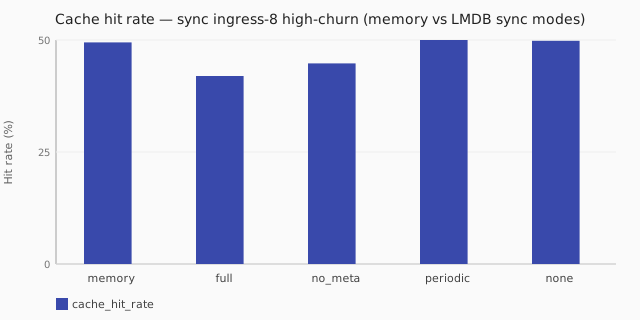
| Lmdb Sync | Hit rate (%) | Cache hits | Cache misses | Achieved QPS |
|---|---|---|---|---|
| memory | 49.7 | 1154131 | 1171660 | 232253.7 |
| full | 42.1 | 12317 | 16919 | 2767.2 |
| no_meta | 45.0 | 20520 | 25094 | 4379.2 |
| periodic | 50.2 | 964032 | 956085 | 191677.2 |
| none | 50.0 | 886097 | 885112 | 176805.2 |
Cache fill mean duration — sync ingress-8 high-churn (memory vs LMDB sync modes)
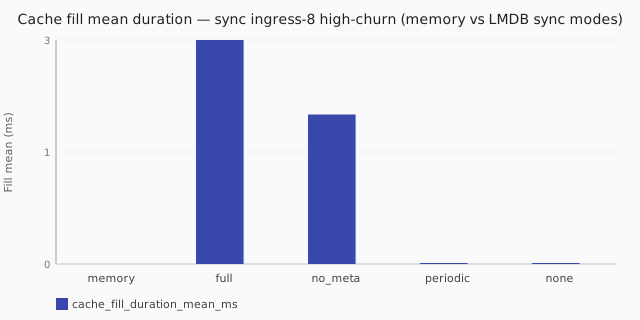
| Lmdb Sync | Fill mean (ms) | Fill samples | Eviction mean (ms) | Eviction samples | Achieved QPS |
|---|---|---|---|---|---|
| memory | 0.0005 | 1171660 | 0.0003 | 1164824 | 232253.7 |
| full | 2.8751 | 16919 | 1.6619 | 14884 | 2767.2 |
| no_meta | 1.9188 | 25094 | 1.0409 | 23629 | 4379.2 |
| periodic | 0.0129 | 956085 | 0.0068 | 954046 | 191677.2 |
| none | 0.0124 | 885112 | 0.0065 | 883086 | 176805.2 |
At a glance
- sync ingress-8 high-churn (memory vs LMDB sync modes):
fullcosts about 99% QPS versusmemory(~3k vs ~232k);no_metacosts about 98% QPS versusmemory(~4k vs ~232k);periodiccosts about 17% QPS versusmemory(~192k vs ~232k);nonecosts about 24% QPS versusmemory(~177k vs ~232k). - Cache hit rate — sync ingress-8 high-churn (memory vs LMDB sync modes):
fullis about 15% lower hit rate thanmemory(~42.1% vs ~49.7%);no_metais about 9% lower hit rate thanmemory(~45.0% vs ~49.7%);periodicis about 1% higher hit rate thanmemory(~50.2% vs ~49.7%);noneis about 1% higher hit rate thanmemory(~50.0% vs ~49.7%). - Cache fill mean duration — sync ingress-8 high-churn (memory vs LMDB sync modes):
full≈ ~2.9 ms vsmemory~0.0005 ms;no_meta≈ ~1.9 ms vsmemory~0.0005 ms;periodicis about 25.8×memory(~0.013 ms vs ~0.0005 ms);noneis about 24.8×memory(~0.012 ms vs ~0.0005 ms).
Takeaway
Under high churn, LMDB write durability dominates QPS on this lab. With eight
sync ingress workers and LMDB shard_count 16, sync: full costs about
99% QPS versus memory (~3k vs ~232k; roughly 83.9× slower). Moving to
no_meta is only about 1.6× full (~4k) — a modest write-path gain.
periodic (this cell uses sync_interval: 1s) is about 43.8× no_meta
(~192k) and costs about 17% QPS versus memory. none lands in the same
high-QPS band (~177k; about 24% versus memory) but skips forced syncs
entirely — on this lab periodic was about 1.1× none. Hit rates stay in
the same band (full about 15% relative lower than memory). Mean fill is
about 2.9 ms for full, about 1.9 ms for no_meta, and about
0.013 ms for periodic and none, versus about 0.0005 ms for memory.
Average latency under the elevated outstanding window tracks roughly
outstanding/QPS and is not raw disk service time. Lazy TTL expiry is
deterministic; LMDB when_full victim selection is arbitrary under entry
pressure. Absolute LMDB churn QPS is disk- and sync-mode-sensitive; prefer
relative claims. That contrasts with warm
cache_hit, where LMDB costs only
about 6% versus memory — see
Memory vs LMDB warm cache_hit.
Before choosing a faster LMDB sync mode for production, you must understand
durability and integrity tradeoffs. Start from the
lmdb.sync decision tree and the
DNS answer cache guide — do not pick a mode from
the QPS chart alone. See also
Performance methodology — LMDB cache cells.
Related guides
Member scenarios
- scale-sync-ingress-8-memory-cache-churn
- scale-sync-ingress-8-lmdb-full-cache-churn
- scale-sync-ingress-8-lmdb-no_meta-cache-churn
- scale-sync-ingress-8-lmdb-periodic-cache-churn
- scale-sync-ingress-8-lmdb-none-cache-churn